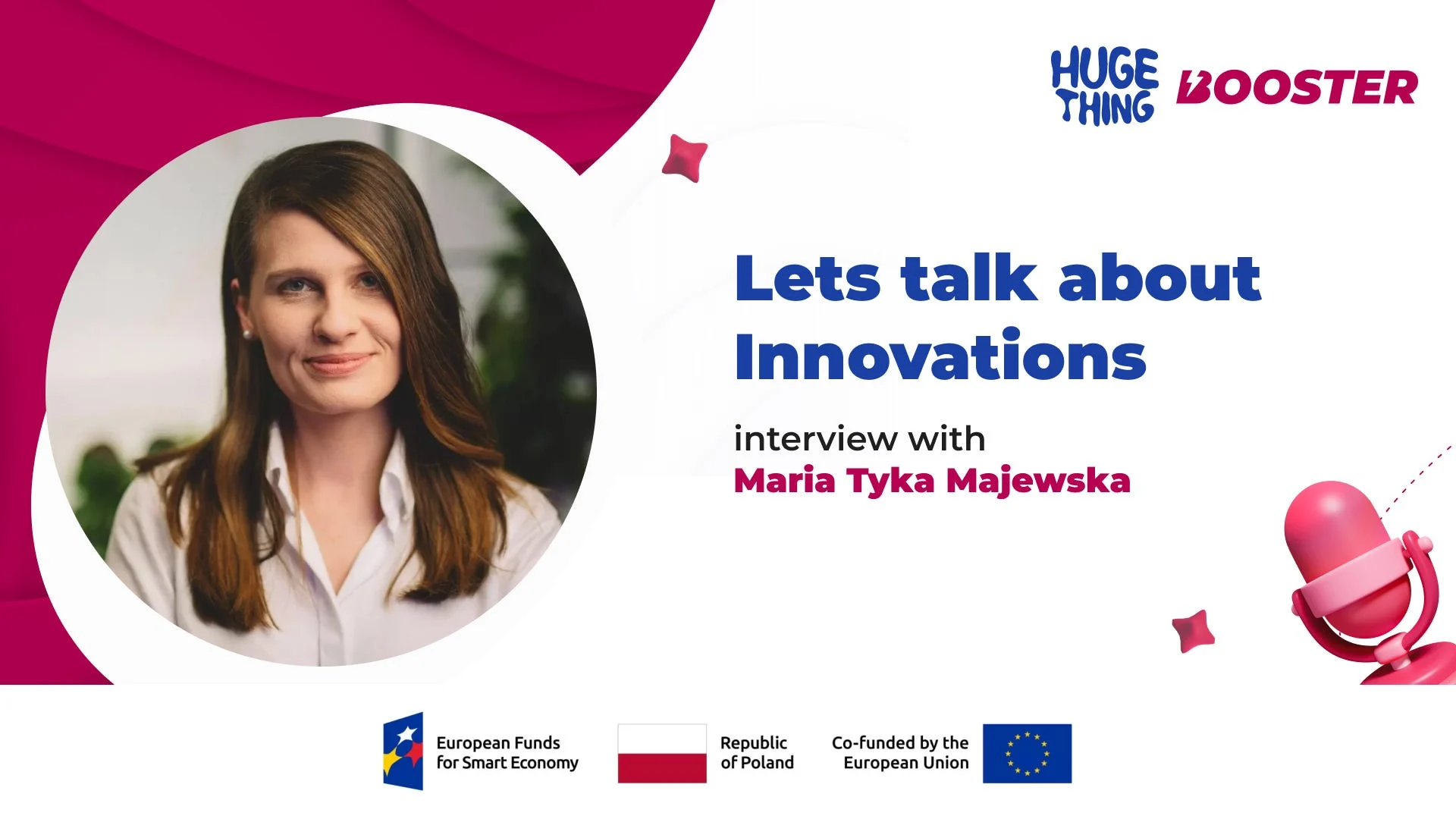
Interview with Maria Tyka-Majewska
The startup world is a rollercoaster of emotions. While we often see brilliant ideas and excitement, we are also aware of many challenges that can be tough for startups to overcome. Raising capital, reaching customers, and developing effective business models are just a few of the obstacles they face.
Where and how to find support on this journey? Can accelerator programs be the answer to the challenges faced by both first time founders and those who are thinking about scaling their businesses globally? To answer all these questions we discuss with Maria Tyka-Majewska from our Huge Thing team. With years of experience organizing acceleration programs, she has guided many successful projects in both the Polish and international markets 💙
They say the real art in business is the ability to observe, so let’s start there. Maria, based on your experience and observations, what is the biggest challenge for founders who dream of scaling their business?
Finance. It’s harsh, but securing funds and the issue of raising is typically the biggest challenge startups face and often a painful collision with reality. Even with numerous available EU programs and a constantly growing number of VC funds looking at the Polish market, obtaining the necessary funds remains the primary obstacle.
Moreover, it’s crucial to carefully and wisely choose an investor as a partner. Venture capital funds and business angels can provide an enormous value of business experience, industry contacts, operational support related to building product development strategies, verifying the business model, or even securing further funding rounds necessary for global scaling.
Do you think acceleration programs can help them address these challenges?
Absolutely. Acceleration programs can serve as a guiding compass for startups, offering comprehensive support in areas like developing growth strategies, market analysis, and securing capital. Many programs cater to specific needs, such as scaling operations internationally, ensuring that the advice given is perfectly suited to the founders’ current stage in their journey.
Another significant benefit of acceleration programs is the opportunity to work with experienced mentors and tutors, who have either walked the startup path themselves or have a corporate background. They understand the market’s specifics from the bottom and can offer valuable advice on the most challenging issues.
Moreover, accelerators often play a crucial role in establishing contacts with companies and opening doors to the corporate world. These connections can result in securing one of the initial strategic partners or clients for startups. Acceleration programs are also an opportunity for corporations to map out their challenges, making it easier for startups to address their solutions to real market needs.
While we scroll through LinkedIn, we come across various acceleration programs. Do you have any golden tips on how to select the most valuable ones as a founder?
There’s no one-size-fits-all recipe for choosing the most valuable program. The key is its alignment with the stage of development, the individual needs, and the startup’s goal. It’s important to pay attention to the quality of the support and whether the accelerator addresses areas essential to your startup. Also, check the team’s experience — who are the people organizing it, and what is their experience working with startups? Certainly, it’s worth seeking out the opinions of other startups that have participated in previous editions of such programs 🙂
Great. As we know, Huge Thing is just about to launch the Huge Thing Startup Booster. Can you tell us more about this initiative and who will find the program most valuable?
I could say our new program is a six-month acceleration process, offering comprehensive support of workshops, mentoring, and the opportunity to collaborate with experienced corporations… but that’s how most accelerators describe themselves.
The key feature of our initiative is its individualized nature. We tailor it to the specific needs of each startup, providing teams with support from carefully selected, experienced tutors and mentors. The program offers three acceleration paths: Industry Test, Sector Agnostic, and Go Global — each addressing specific challenges and each valuable for startups at different stages of development. Entrepreneurs can choose the path that best suits their situation and current needs.
What’s worth mentioning that distinguishes Startup Booster is our network of renowned corporate partners. We collaborate with companies like Saint-Gobain, Rossmann, Veolia, and Bank PKO. These partnerships are not just by chance — they’re our long-standing partners whose needs we deeply understand. As a result, we can share unique knowledge and expertise with startups, providing them entry to new business opportunities.
Another significant advantage is the close cooperation with numerous Venture Capital funds, including huge support from SpeedUp Venture Capital Group, from which Huge Thing originates. This enables startups to gain access to discussions and support from experienced investors and, ultimately, a real chance to secure capital for further development.
You mentioned the program’s paths. Could you tell us more about them, who should apply, and which one they should apply to?
Yes, as I mentioned, Booster offers three pathways: Industry Test, Sector-Agnostic, and Go Global.
The Industry Test path is a perfect opportunity to test your solutions in collaboration with major corporations. Partners such as Veolia, Saint Gobain, PZU, Żabka, PKO BP, Alior, Rossmann, and CPI Property Group pose specific challenges that they face, such as production management, customer service, or security issues. Startups applying to this path should have refined technology that has already passed laboratory testing and is ready for adaptation in a large corporation. In addition to a six-month acceleration program, the initiative offers grants of up to 350,000 PLN, access to infrastructure and resources from business partners, mentoring, support from experienced experts, and the chance for a pilot implementation in a real-life scenario.
In the Sector Agnostic path, the goal is the development of technology and product. In contrast to the Industry Test path, this one focuses on startups in need of further financing for testing and refining their solutions. The business model may still be in the refinement stage — what matters is the potential inherent in the technology. This initiative offers a six-month acceleration program with grants of up to 200,000 PLN, as well as support in refining technology and the business model, mentoring and advice from experienced experts, and access to a network of contacts and potential investors.
The third path, Go Global, is addressed to businesses with a product already operating in the Polish market or locally in neighboring countries with plans to expand their operations to markets in the United States, Germany, or Asia. During the program, startups can expand their activities through comprehensive support for business scaling and gain the opportunity to get grants reaching up to 350,000 PLN. We offer support in entering foreign markets through collaboration with partners operating in the target countries. Program participants can also expect close collaboration with local investors or business partners.
You also mentioned the challenges from corporate partners that participants of the Industry Test are supposed to address. Could you tell us a bit more about who you are partnering with and the solutions they are looking for?
When creating the program, we aimed to select a very diverse group of partners to address a wide range of challenges. Applicants can find detailed descriptions of them on our website and choose the ones that best suit their startup. For example, Saint-Gobain, a world leader in lightweight and sustainable construction, challenges startups to identify bottlenecks in the laminated glass production line and develop technologies to improve the recycling of flat glass. This is just one example; we also have partners from the retail and financial sectors, as well as the City Council, so the list of challenges is extensive, which personally makes me very happy.
Finally, we would like to ask about the recruitment process and your experiences with it. What are the most common mistakes you’ve seen among startups applying to such programs, and what should they pay particular attention to?
Recruitment for all paths will open soon, and the registration form will be available on our website. Until then, we have opened the waiting list so you can be updated when recruitment opens.
The most common mistakes I’ve seen often result from rushing through the process. Founders provide a superficial description of their business or fail to highlight the specific competitive advantages of their business. It’s important to present your business thoughtfully and clearly, which naturally takes time.
For our program, when applying to an Industry Test path, it’s crucial to thoroughly understand the challenges set by our partners. The partner actively participates in the technology testing process, providing infrastructure and being involved in the evaluation.
Thank you very much for the conversation! If readers have additional questions, can they contact you directly?
Of course!