Only a few years ago, collaboration between a bank and young external tech companies sounded like a jigsaw that was hard to put together. Today it’s an everyday reality, although it still takes a good framework, trust and patience on both sides.
PKO Bank Polski, one of Poland’s most important financial institutions, has spent years exploring how to combine stability, convenience and security for its customers with the courage to experiment. One of the tools in this strategy is its participation in Startup Booster by Huge Thing, through which the bank tests young companies’ solutions in practice, from VR training and environmental tools to cybersecurity.
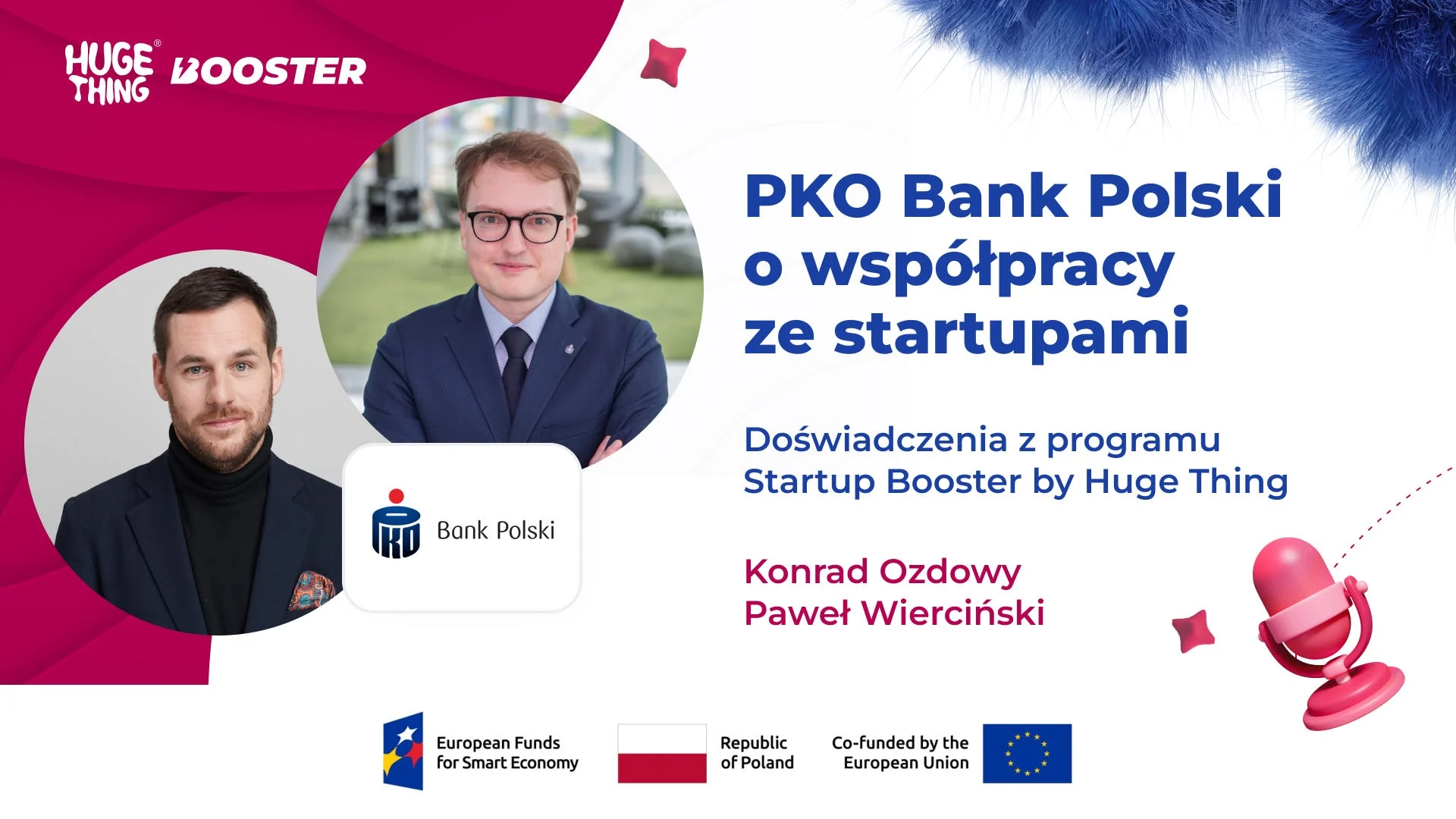
To find out what this collaboration looks like behind the scenes, we interviewed Konrad Ozdowy, Product Manager, and Paweł Wierciński, an expert at PKO Bank Polski. We asked them what works, what surprised them during the pilots, which myths still circulate among startups and where they see the greatest potential for the future.
PKO Bank Polski is an institution with more than 100 years of history and a symbol of stability in the Polish financial system. How do you preserve that identity while opening up to innovation and collaboration with tech startups?
Stability, trust and innovation are not in conflict. At PKO Bank Polski, they are parts of the same strategy. We understand stability as responsibility for the financial system and for the security of our 12 million customers, but also as the ability to adapt quickly. In a world where banking is becoming digital-native and the competition is less and less often made up only of traditional financial institutions, staying the market leader requires openness to new technologies.
On the one hand, we keep strengthening our foundations by investing in infrastructure, security, regulation and processes. On the other, we offer startups a dedicated path for innovation and collaboration – Let’s Fintech with PKO Bank Polski.
Your involvement in Startup Booster by Huge Thing didn’t happen by chance. Let’s take a step back – what prompted you to join the programme? Was it part of a broader innovation strategy, or a specific business need?
When we created our startup collaboration programme, we were guided by the conviction that it’s worth investing in the development of the whole Polish innovation ecosystem. Acceleration programmes such as Startup Booster by Huge Thing are a key part of that process. The partnership gives us a synergy that brings together technology, entrepreneurship and the ability to scale solutions with real business potential quickly.
We believe that the largest bank in Poland – together with its partners – should not only ensure the stability of the financial system, but also create conditions in which young tech companies can grow, experiment and think boldly about global expansion.
Programmes like Startup Booster by Huge Thing can be a catalyst for change, not only in terms of the solutions implemented, but also in terms of internal organisational culture. From your perspective, what role do such initiatives play in building a culture of innovation inside a large financial institution?
Building a culture of innovation in a large organisation is a long-term process. We’ve learned from our own experience that this kind of transformation requires proven partners and a clear framework. Partly thanks to our collaboration, we spark technological curiosity internally, encourage teams to be open to new models of working together and give them a fresh perspective on the challenges that come with the current corporate structure. As a result, we strengthen not only the organisation’s ability to implement new technologies, but also a proactive attitude focused on growth, experimentation and boldly looking for value for customers.
In this edition of the programme, you worked with three startups: Mazer, 1Strike and PlanBeEco. What surprised you most during these pilots – the technology, the teams’ approach or perhaps the pace of work?
We’ve been testing young tech companies’ solutions regularly for more than five years and have already run close to a hundred pilots. As a result, we have a well-established process and know what to expect at each stage of a Proof of Concept. That’s exactly why we particularly appreciate the moments when startup teams surprise us positively – with their pace, the quality of their preparation or the way they think about a problem. We chose these three projects from several dozen applications because they best addressed specific business needs within the bank.
Mazer showed how quickly immersive training for VR headsets can be created, which opens up entirely new learning opportunities for our HR department. PlanBeEco delivered a carbon footprint measurement tool that could genuinely support our customers in the area of environmental responsibility. And 1Strike proved its worth in the work of our cybersecurity department, addressing everyday challenges related to risk analysis and system resilience.
Getting from the first contact with a startup team to launching a test within the bank is a process that can be challenging for many companies. What does it look like for you? How do you combine a startup’s momentum with the processes typical of a large organisation?
From the very first contact, we focus on matching the solution to specific business needs. That way, the startup knows from the outset the expected functional scope, the success metrics and the business unit responsible for the next stages of the collaboration.
The key is balancing the momentum of a young tech company with the requirements of a large financial institution. That’s why we work in clearly defined phases: verification of the technology and operating model, subject-matter workshops with the bank’s teams, simplified due diligence and a pilot run in a controlled environment. This model lets us maintain full regulatory compliance, risk control and architectural consistency, while keeping up the pace of collaboration that is so important for startups.
Did any of the projects stand out for its potential to scale, or bring a new perspective you hadn’t considered before?
Each of these projects represented a completely different area of the bank’s business and very different audiences, so it would be hard to single out one as “the best”. What really mattered to us was that all three teams showed a very high level of professionalism, and their solutions proved genuinely useful in the organisation’s day-to-day processes.
Each of these pilots shifted our perspective in a slightly different direction: from VR learning, through environmental tools, to cybersecurity. That’s why we see them not as competing initiatives but as three equally valuable projects. We’ll continue working with each of them, which means they all passed with flying colours.
What are the most common challenges you face when piloting and testing innovations? And how do you deal with them?
The most common challenges we face during pilots fall into two main groups: external and internal. The first stem from the natural differences between how startups and large organisations operate. Young companies often don’t realise that in a corporation, processes take longer regardless of goodwill, and even simple projects require complete documentation, procedures and formal sign-offs. So it can happen that preparing materials or meeting compliance requirements turns out to be a bigger challenge for a young tech company than it expected at the start.
The second group of challenges is internal, on the corporate side. Large institutions don’t always immediately understand a startup’s rhythm, its flexibility or its limited resources. Bank teams sometimes also expect a young company to follow the same processes and level of formality that apply inside the organisation, which can lead to unnecessary tension or delays.
This is, however, an area that can be managed, and that’s exactly why specialised collaboration programmes such as Let’s Fintech with PKO Bank Polski exist.
Startups often have their own vision of working with a bank, and then they run into the realities of a large institution. What are the most common myths startups need to rethink right at the start of a collaboration?
Although a lot depends on a startup’s stage of development, there are two myths young companies most often have to confront. The first is the belief that a great idea alone is enough to quickly change the way a large bank operates. In reality, we work in a heavily regulated environment, where even the most promising technology has to meet specific legal, security and compliance requirements.
The second common myth concerns the pace of implementation. Startups often assume that integrating their solution at the bank will happen at the rhythm they’re used to in their own environment. In practice, the process always takes longer, because we’re talking about systems and processes serving millions of customers, which demand stability, testing and the highest quality standards. Understanding this difference at the start of the collaboration helps avoid disappointment and lets startups plan their work better.
It’s well known that sometimes the biggest lessons come from failed projects that don’t achieve the intended results. Can you share the lessons you’ve learned from unsuccessful tests?
It’s true that not every project ends in success, but that’s exactly why we created the Let’s Fintech programme a few years ago. Its role is to test external solutions safely and verify their real usefulness before the bank decides on a full rollout or on building the technology in-house. This lets us separate promising ideas from those that ultimately don’t fit our processes, architecture or customer needs.
The most important lesson from projects that didn’t make it to commercialisation is always the same: the better the problem fit and the more realistic the expectations, the greater the chance of success. Pilots teach us about technology and about how to design future collaborations more effectively.
On the other hand, were there solutions that exceeded your expectations and delivered better results than you originally assumed?
In many pilots, the final results turn out better than we initially assumed. That’s natural when working with solutions that often go beyond the traditional areas of banking. A good example is our collaboration with Instreamly, a startup creating innovative advertising formats in the gaming world, built on the reach of micro-influencers. Not long ago this channel seemed niche; today it’s one of the most promising ways of reaching younger customer groups.
The pilot delivered above-average results, so the PKO VC fund decided to invest in the company. Today Instreamly is responsible for building our presence on one of the largest gaming platforms in the world – Fortnite. It’s an example that shows how openness to new formats and bold testing of unconventional solutions can produce results far beyond the original assumptions.
How would you sum up the greatest added value of working with startups in the Startup Booster by Huge Thing programme?
The pace of change in the innovation ecosystem is so fast that working with Huge Thing is an important complement to our own activities. Thanks to Startup Booster, we can assess young companies’ potential earlier and more precisely, understand their technologies better and check how they can realistically operate in an organisation of our scale.
The accelerator also brings an additional perspective and tools that let us test solutions faster and more methodically than we could on our own. In practice, this speeds up the selection of projects with the greatest business value and makes it easier to prepare startups for the next stages of collaboration.
Banking is undergoing a huge transformation today, from process digitalisation, through AI, to ESG. In your view, which of these areas will be most open to innovation from startups in the coming years?
From the perspective of strategically seeking new directions for growth, the key will be finding ways to use AI at full scale. Not only generative AI, but also AI in risk, operations and personalisation. These areas remain a central focus of analysis at every large financial institution.
At the same time, banks are paying more and more attention to post-quantum technologies, understood not as distant futurism but as a necessary preparation for the next security cycle of financial infrastructure. Robotics and hyperautomation are also on the radar, especially in terms of combining process automation with AI into a single, adaptive operational layer – not just for savings, but for organisational scalability. Space tech is another area under increasingly close analysis, particularly advanced satellite analytics for ESG and physical risk, as well as communications infrastructure. These are not yet decisions about “implementation in the near future”, but areas that call for deliberate exploration before they become market standard.
Finally, one question for everyone building a startup today who would like to work with an organisation like PKO Bank Polski one day. What one piece of advice would you give them? What should they be aware of before entering the world of collaboration with a large institution?
The advice is fairly simple: come with a specific problem you can solve better than the competition. At the same time, when you consider working with institutions the size of our bank, pay attention to how diverse the needs of its customers are. In the case of PKO Bank Polski, they range from large corporations, SMEs and micro-businesses to individual customers across every segment.
That’s why we’re interested not only in technologies that make our internal processes more efficient, but also in those that genuinely strengthen the businesses of the people who use our services. These could be solutions that make it easier for companies to manage their finances or that raise the level of automation or security, but also satellite technologies that, for example, help farmers assess the condition of their crops, anticipate the effects of weather changes and make better-informed investment decisions. This allows us to create precise, modern financial products for them.
Even though we operate in banking, we don’t limit ourselves to working with fintechs. We look for technologies that solve specific challenges, whatever the industry. AI, deep tech, space tech, ESG, cybersecurity, data quality and process automation are the areas where we see the greatest potential and where startups can genuinely help shape the future of financial services.
As you can see, a “big bank” and “young technology” don’t have to be on opposite sides of the barricade. Well-designed collaboration, clear expectations and a willingness to learn on both sides turn pilots into real implementations and long-term partnerships.